

My dearest English Enthusiasts,
It brings me great pleasure to announce the arrival of the English Enjoyed app: master your English in ten minutes a day.
As a subscriber to this newsletter, you are among the very first to see it. This is an exclusive look before the app is announced to everyone else.
This is the most audacious project I have undertaken to date, and I dearly hope that you will enjoy using it as much as I have enjoyed building it.

The problems it solves
You already know English well, yet you lack the precise words to express exactly what you mean.
You resolve to improve your English and vow to study diligently for an hour every day. It starts brilliantly, but by day three something breaks the momentum, and the system lies in ruins.
Perhaps you do keep a system: a notebook of words, a few grammar rules looked up. Only you never look at them again, and the words and rules go unlearnt.
Vocabulary. Grammar. Recall. The app solves all three at once.
The Evergreen Method for everlasting English
Spaced repetition
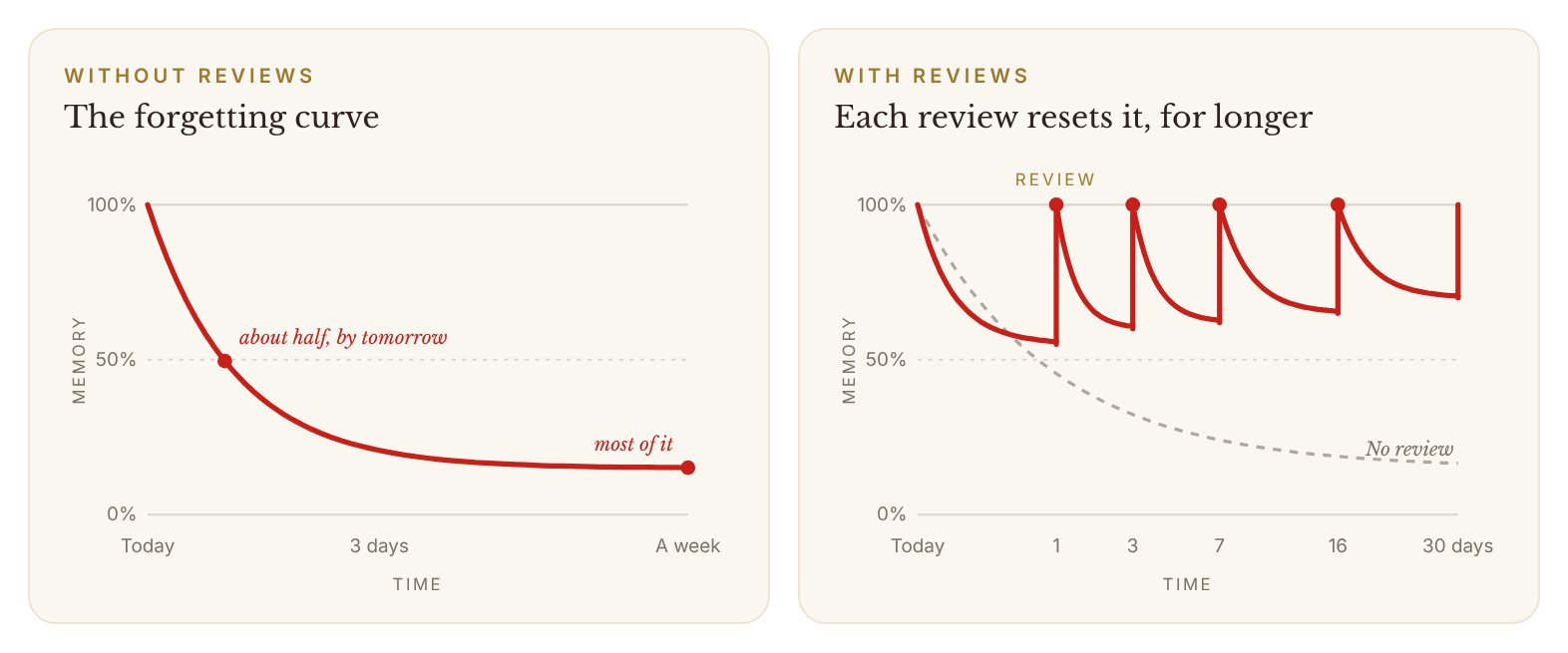
In 1885, Hermann Ebbinghaus measured how quickly we forget: about half of something new is gone by the next day, and most of it within a week.
However, if one reviews a word at the precise moment one is about to lose it, the memory does not merely survive—it strengthens. English Enjoyed calculates that moment for every card you hold, and asks you to recall it then.
If you recall it correctly, the card advances further into the future. If you do not, the app notes this, and you will meet that card again sooner.
One card, one idea
Piotr Wozniak, who wrote the first spaced-repetition program, called it the minimum information principle: simple cards are learnt faster, retained longer, and recalled more reliably than complicated ones.
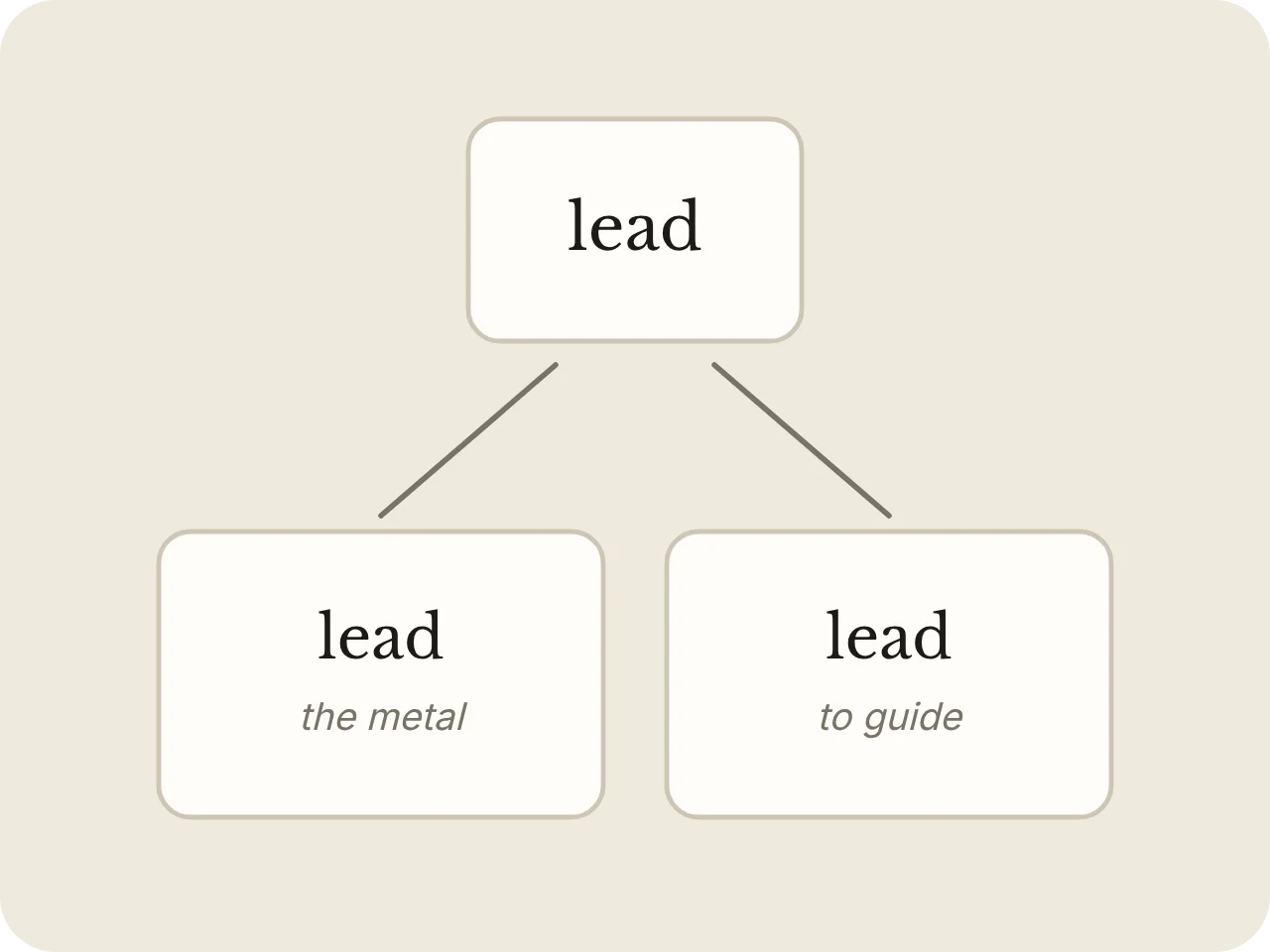
So every card asks you to remember one thing. Lead the metal and lead the verb are two cards, and each grammar topic is broken into its separate rules, so that you can learn each one cleanly.
Words in context
We do not learn a word by staring at its definition. We learn it by meeting it in a novel, a conversation, or a film, embedded in a sentence, surrounded by the context that gives it life.
A word written in a notebook has no context to anchor it. How would you know that anchor can be used figuratively, unless you saw it used so? (See the previous sentence.)
So every word comes with three sentences, written to show it in different settings, and each review asks for the next. Here is mollify:
Not even a word from the chef himself could mollify the diner, whose soup had arrived cold for the second time.
Her neighbour, still furious about the hedge that had been cut without his leave, seemed somewhat mollified by a handwritten apology.
Offended by the young critic’s review, the old novelist was soon mollified by her evident admiration for his early books.
You can hear words spoken aloud too, recorded in my own voice, with more added every week. A word you do not know how to pronounce is a word you will not use.
What to expect
Your daily Refined Ritual
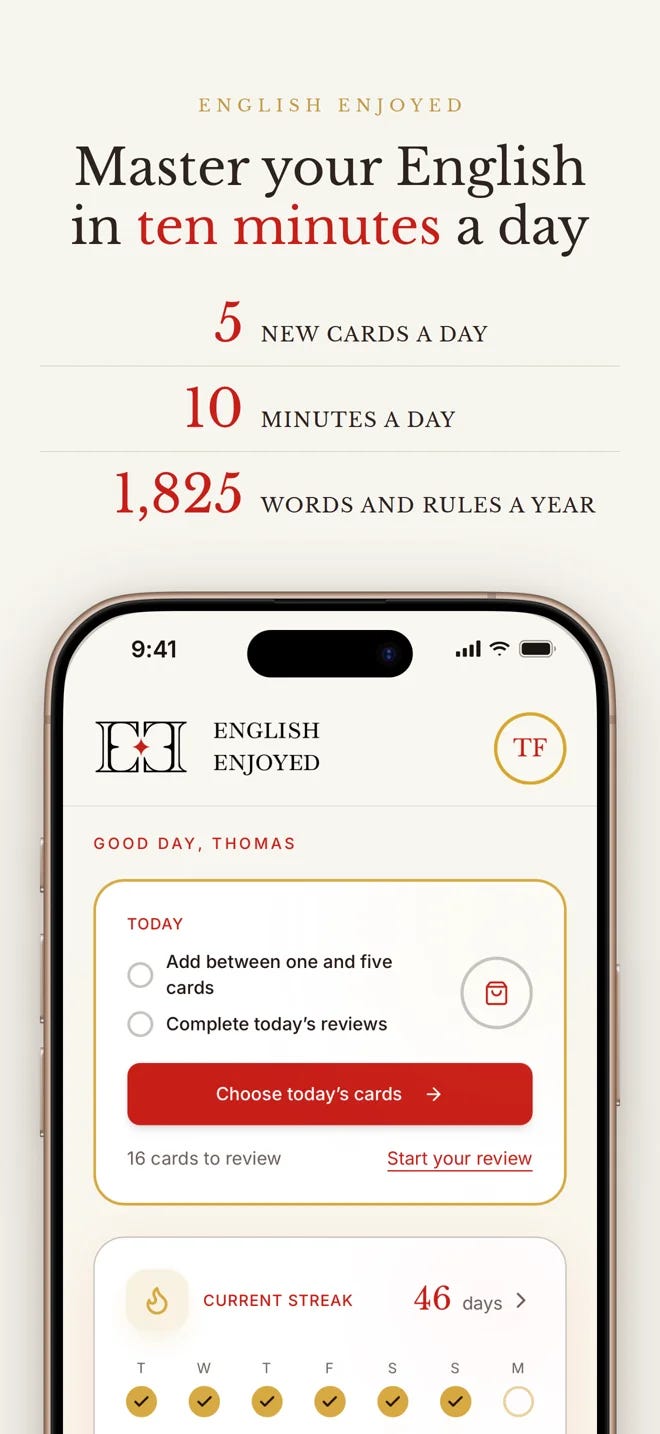
Every day, the app invites you to add between one and five new cards—words, idioms, grammar rules, or punctuation rules, chosen by you—and then to complete your reviews.
Why five?
The Rule of Five is not a restriction upon your ambition. It is the protection of it.
Every review pile that has ever collapsed did so for the same reason. Somebody added ninety cards on a Sunday because inspiration struck, and by the following Thursday nine hundred reviews were waiting—and no human being alive opens that app ever again.
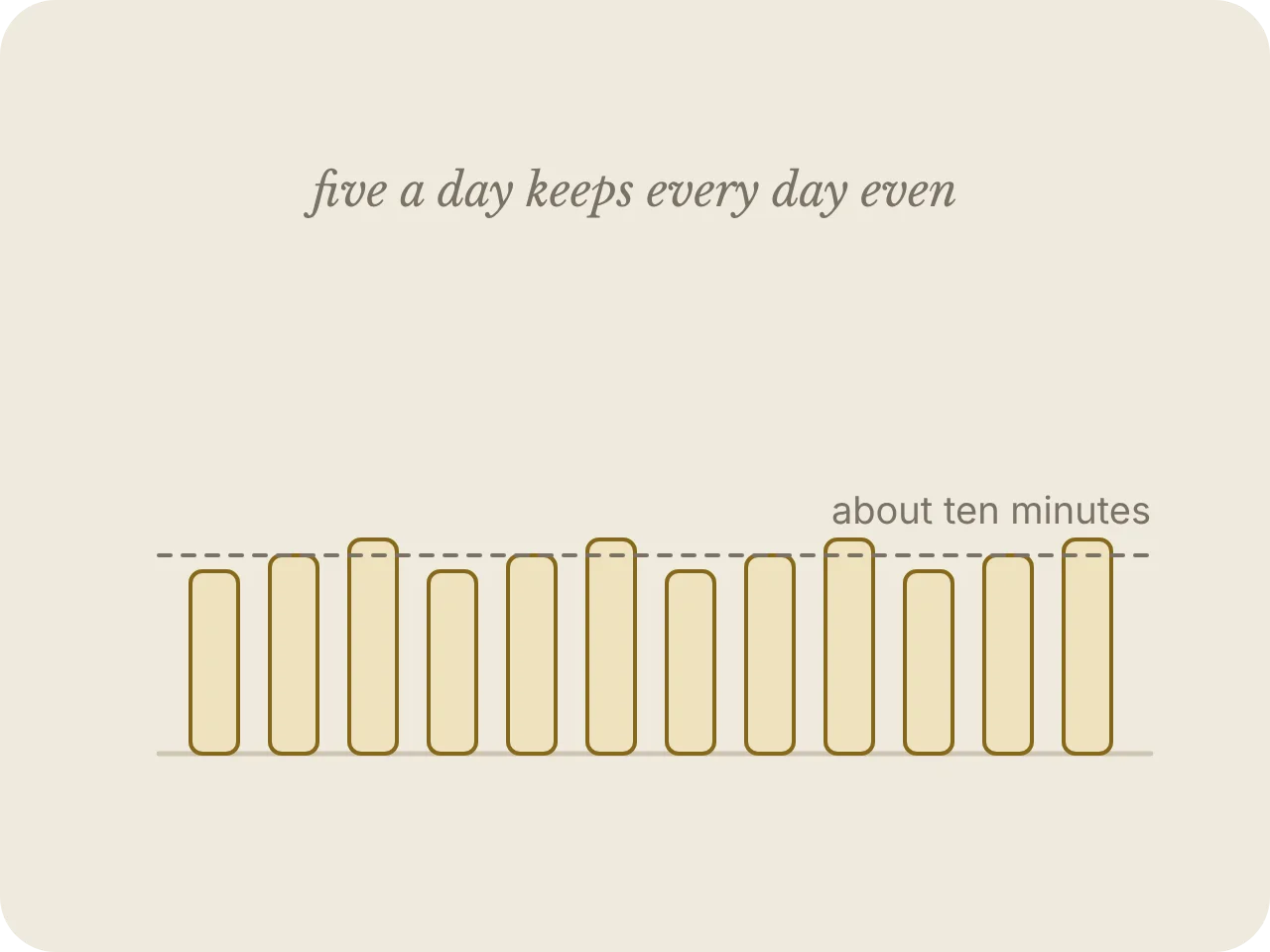
Five a day does not collapse. Five a day is survivable during your worst week: the impending deadline, the flu, or the house move. It keeps your reviews to about ten minutes a day.
5 new cards. 10 minutes a day. 1,825 new words and rules a year.
Your first meetings
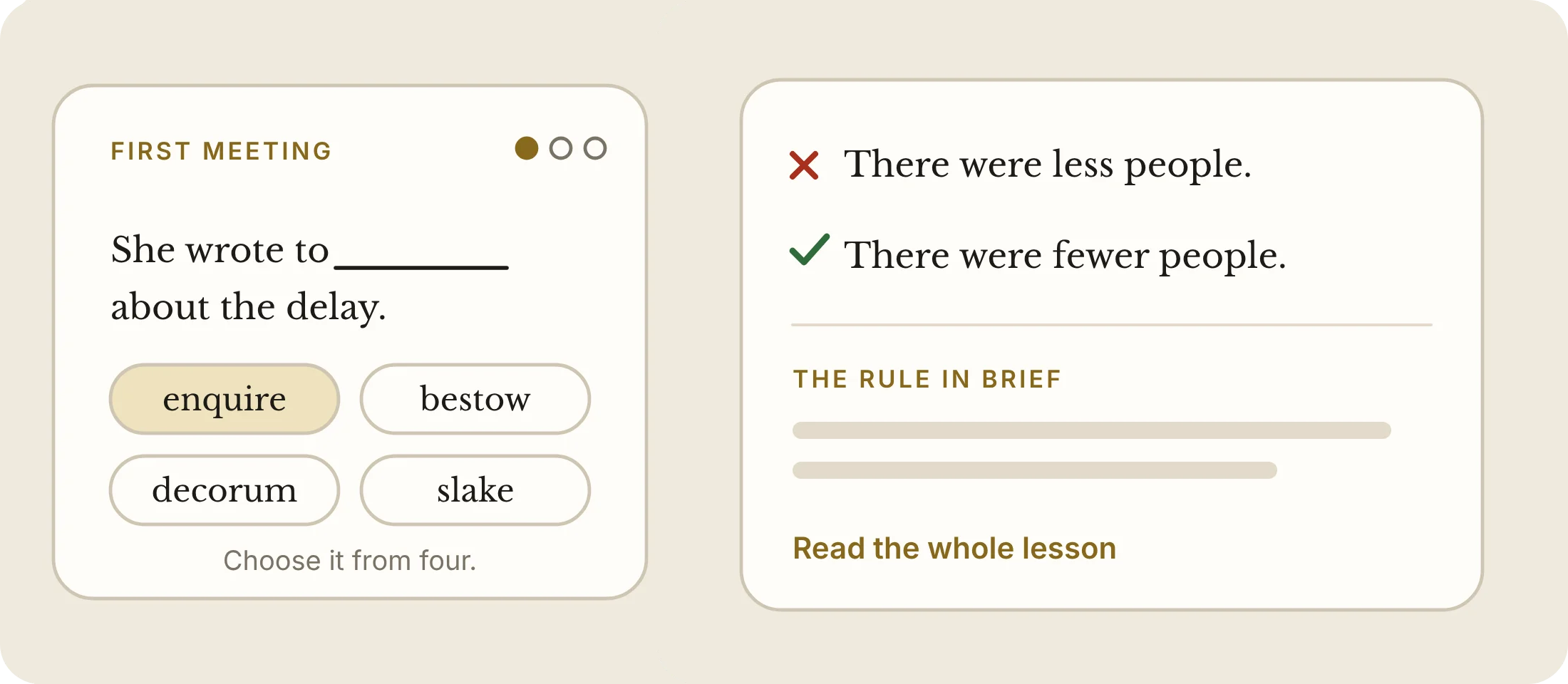
When you add a new word, it is first introduced: its meaning, its sound, and a sentence. Then you meet it three times, with a little less help each time:
Choose it from four options.
Type it, knowing how many letters it has and the letter it begins with.
Type it, knowing only how many letters it has.
From the next day, you recall it from memory alone, with a Hint button should you need one.
A grammar or punctuation rule begins with a question, asked before you have read the rule. Answer as best you can: that first answer is never marked. Then you see the rule as two sentences, one with the mistake and one without, followed by two more questions.
Track your progress
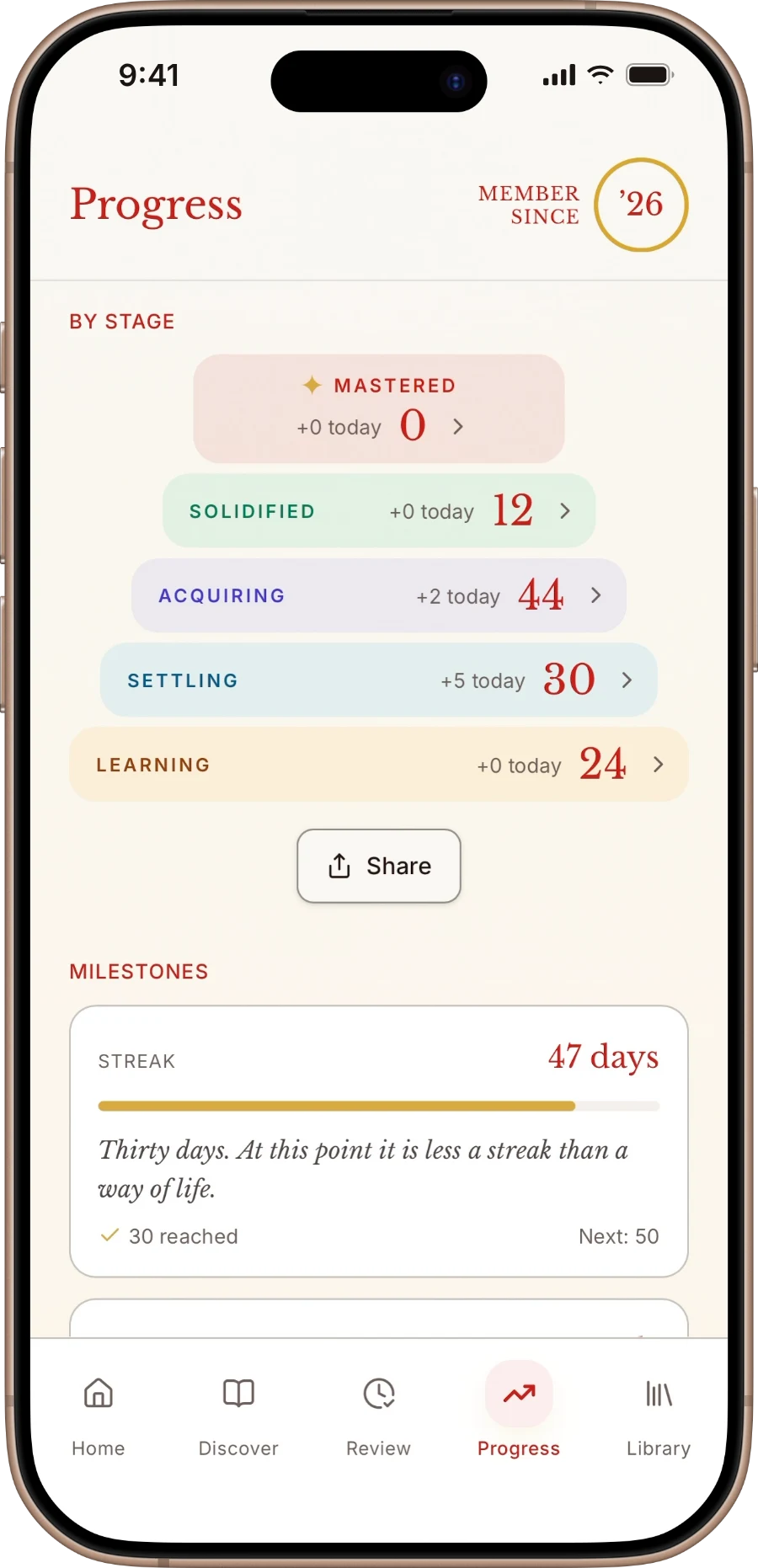
In this century, we do not suffer from a shortage of information; we suffer from a shortage of accountability. Think of your streak and the Progress tab as an accountability partner, keeping you on course.
The Elevation
Every card stands on one of five stages, according to how long the memory would last without a review: Learning, Settling, Acquiring, Solidified, and Mastered.
A card earns the status of Mastered only when you would remember it for a full six months without seeing it once.
We chose a demanding measure on purpose, because a number that flatters you is not a measurement. It is a decoration. At English Enjoyed we have high standards, and there are no medals for mere participation. This status you will have to earn—and when that figure climbs, it means something.
Your own linguistic library
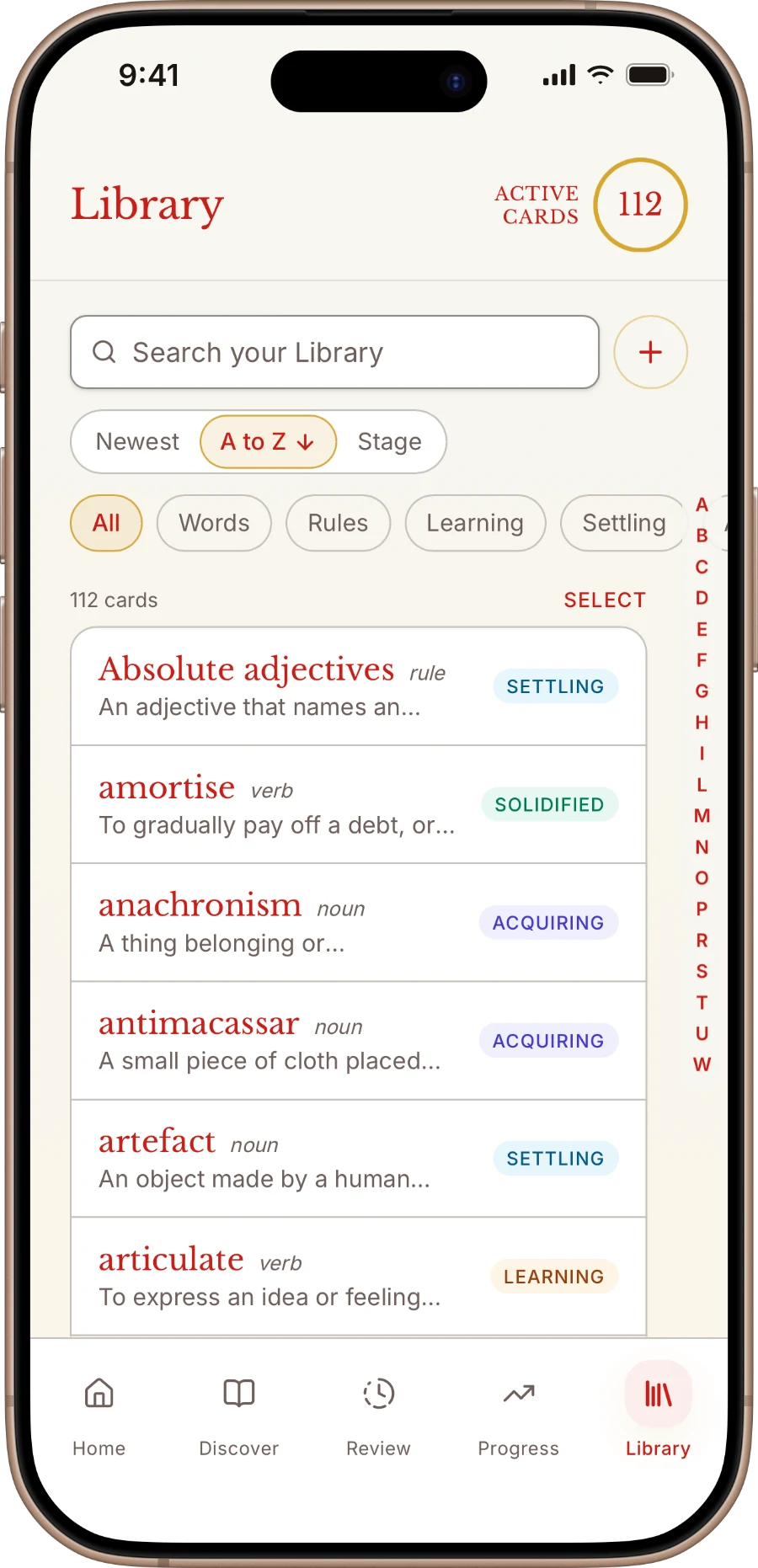
All your cards are kept in your Library.
It is not a word list. It is a library—catalogued, beautiful, and assembled by nobody but you. Every card in it is there because you decided that something was missing from your English, and resolved to put it right.
You may sort your collection by newest, alphabetically, or by stage. You may search it. You may open any card and read its definition, its grammar rule, and its sentences. And should you meet a word in a novel that we do not yet hold, you may add your own.
How I know it works
I speak with some confidence on this matter, because this is not a method about which I have merely read. It is the method by which I have improved my own French, Spanish, and English (yes, even my first language), and by which I continue to do so, day after day.
Here is how you will know it has worked: one day, some months from now, you will be in conversation, and you will say punctilious, amortise, or mollify—correctly, in context, without hesitation, and without the faintest recollection of having learnt it.
What the app cannot do
Let me take a moment to be candid about what this app is not. English Enjoyed will not replace a teacher. It will not replace live conversation, watching films, reading novels, or the irreplaceable business of making a fool of oneself in a foreign language in a bar. Nothing replaces that.
What it does supply is the bricks: the words, the rules, and the expressions—the small, sturdy, interlocking pieces from which every sentence you have never said before will be built.
We handle the bricks. You build whatever you like.

Download today
One thousand eight hundred words and rules a year, held not in a notebook destined to be lost, but in the only repository that has ever mattered: your own long-term memory, permanently, and on demand.
The app requires a subscription, and the first 14 days are free. We shall email you two days before your trial ends, so there are no surprises.
Download today and start your 14-day free trial.
Should you meet any difficulty, please write to support@englishenjoyed.com.
With warmest regards,
Thomas