


Do you despair when it comes to using this minuscule punctuation mark? Do you want to pull your hair out over possession? Do you ever confuse let’s and lets?
Despair no more. I have the guide to help you soar.
How to use it:
1. Omitting letters and forming contractions
One of the primary functions of the apostrophe is to mark where letters have been omitted. E.g. I’m, they’re, don’t, mustn’t, etc. We call this a contraction. No, it has nothing to do with childbirth—though you may well experience contractions by the end of this explanation.
Contractions make speech more fluid and conversational, and they can make writing more informal and efficient.
As a general rule, avoid using too many contractions in formal writing such as reports or legal documents. However, omitting them entirely can make your prose feel stilted or robotic.
Be ware of the most common mistakes: it’s and let’s.
It’s is a contraction of ‘it is’ and its is the possessive form of ‘it’.
It’s raining. (It is raining).
The horse lowered its head. (The head belonging to the horse).
Let’s is a contraction of ‘let us’, and lets is the verb meaning to allow permission.
Let’s not forget that our membership lets us enter for free. (Let us not forget that our membership allows us to enter for free).
2. Demonstrate possession
Paradoxically—and somewhat maddeningly—to what is stated above, the apostrophe can also be used to show possession. Possession is when one noun (a person, a place, or a thing) owns another noun. Pay close attention; this is where it can get complicated.
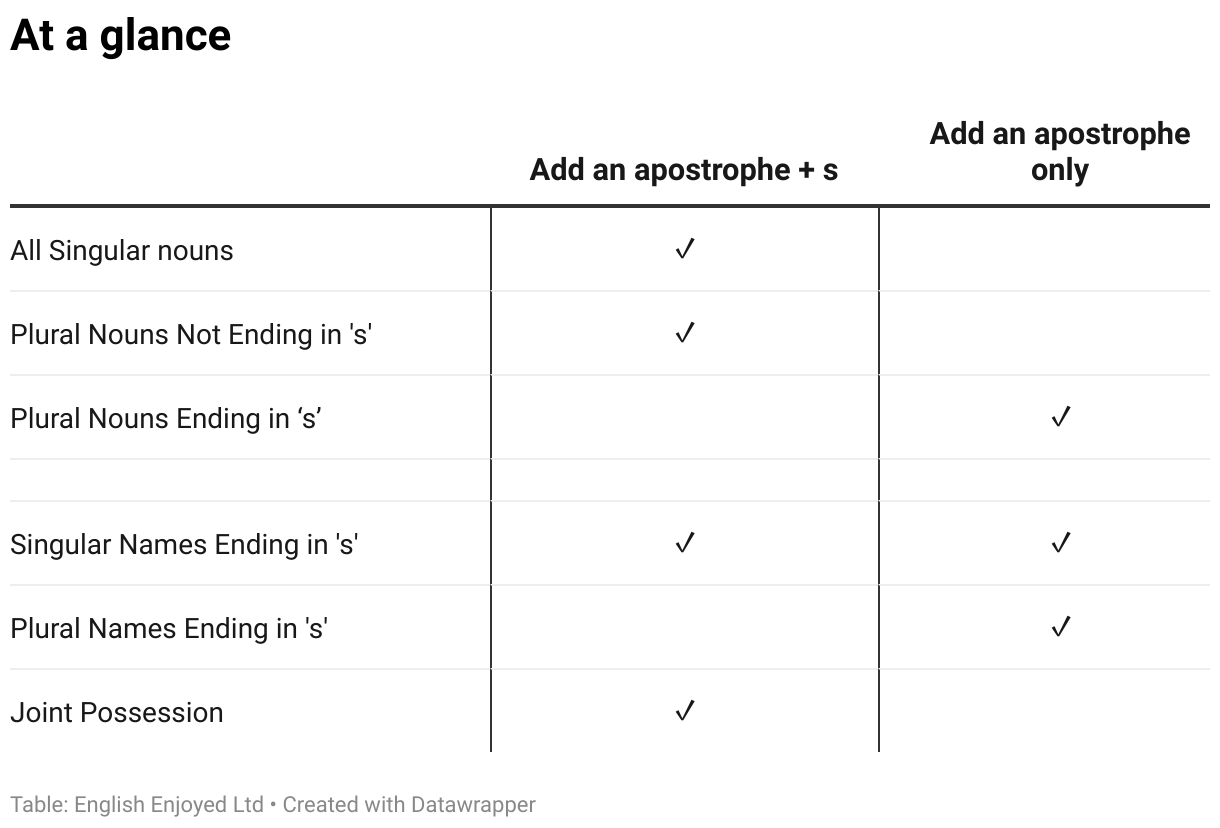
a. Singular Nouns:
For all singular nouns, regardless of whether they end in an ‘s’ or not, add an apostrophe + s to show possession.
The chef’s kitchen is spotless.
Our car’s windscreen is cracked.
My dress’s sleeves are too long.
The bus’s seats were uncomfortable.
b. Plural Nouns Not Ending in 's':
For irregular plurals that don’t end in an ‘s’, add an apostrophe + s to show possession.
The children’s toys. (The toys belong to the children).
The mice’s nest. (The nest belongs to the mice).
The geese’s tracks. (The tracks belonging to geese).
c. Plural Nouns Ending in ‘s’:
As a reminder, to form the regular plural of nouns in English we simply add an ‘s’ to the end:
Chef → Chefs
For singular nouns that already end in ‘s’ we add an ‘-es’ to form the plural:
Dress → Dresses
Bus → Buses
Therefore, for all plural nouns ending in ‘s’, add only an apostrophe after the ‘s’ to show possession.
The chefs' kitchen is spotless. (The kitchen belonging to more than one chef).
Notice how the small movement of the apostrophe from chef’s to chefs’ changes whether something belongs to one or multiple chefs.
My dresses’ sleeves are too long. (The sleeves belonging to multiple dresses).
The buses’ seats were uncomfortable. (The seats belonging to multiple buses were uncomfortable).
d. Singular Names Ending in 's':
Names are also nouns; however, this is an area where things can get complicated because it is a question of style, rather than rules, which is why I have separated them. Different style guides will propose different options.
You can either add an apostrophe + s (or only an apostrophe after the ‘s’).
Correct: Iris's book was missing.
Also correct: Iris' book was missing.
Personally, I prefer the apostrophe + s as this keeps everything consistent for all singular nouns whether they are names or not.
Thomas’s videos.
St James’s park.
Thomas’ videos and St James’ Park are also correct—just pick a style and stay consistent.
e. Plural Names Ending in 's':
It can become particularly challenging when you are are talking about multiple people whose name ends in ‘s’. Compare:
We are going to the Smiths' house for a party.
Smith (singular) → Smiths (plural) → Smiths’ (plural possessive)
Whereas “Jones” would differ. To make the plural possessive of Jones we add the ‘-es’ as we would for other singular nouns already ending in ‘s’, then simply add only an apostrophe:
We are going to the Joneses' house for a party.
Jones (singular) → Joneses (plural) → Joneses’ (plural possessive)
Follow the same rule as Section 2c: if the plural ends in ‘s’, add only an apostrophe after it.
f. Joint Possession:
If two people jointly own something, add the apostrophe + s only to the second name.
Incorrect: Jane’s and Tom’s house (implies two separate houses)
Correct: Jane and Tom’s house (Jane and Tom both own the house).
Victorian Writers Then & Now

If you enjoy long sentences, elevated language, and polysyllabic vocabulary. You might enjoy my upcoming book Victorian Writers Then & Now. It is a collection of published and not-yet-published passages based on my Victorian Writers series of videos. Each part includes a short passage lovingly ‘translated’ in Victorian style followed by a contemporary, modern-day utterance.
A hardback, clothbound volume with eight hand-drawn illustrations; it is a book to display proudly, return to often, and gift—if you feel inclined—to someone with very good taste.
*Please note the book is currently in pre-order and will ship mid to late July 2025*
C. Demonstrate plurality
There is a rare edge case where the apostrophe can be used to demonstrate plurality, when certain letters are used as nouns. Again this is a question of style, not necessarily a rule. For example:
She achieved five A’s and two B’s.
Without the apostrophe, A’s could be confused as the word ‘As’.
Remember to cross your t’s and dot your i’s.
Without the apostrophe, i’s could be confused as the word ‘is’.
Unless absolutely necessary for clarity, omit the apostrophe.
Anti-apostrophe?
There are certain minimalist camps who believe we should do away with apostrophes entirely. Whether you agree or not, you can avoid them by rephrasing:
We are going to a party at the house of the Joneses.
The kitchen belonging to the chef is spotless.
The sleeves of my dresses are too long.
Linguistically yours,
Thomas
P.S.
Follow on Social: Instagram, TikTok, YouTube—join me for more writing tips, grammar insights, vocabulary suggestions, and enjoyment of the English language.
Sponsor This Newsletter: Get in touch if you would like to partner or support my work.
Thank you for reading, and may your words always find their perfect form.
You are announcing a rather exquisite hardcover book. But will there also be an audiobook version of you perfectly articulating all the polysyllabic and elevated vocabulary?
Thank you so much, Thomas, for your brilliant and clear explanation! 🙏I will use it in my English lessons for Italian native speakers. 👍🇮🇹🇬🇧